Background
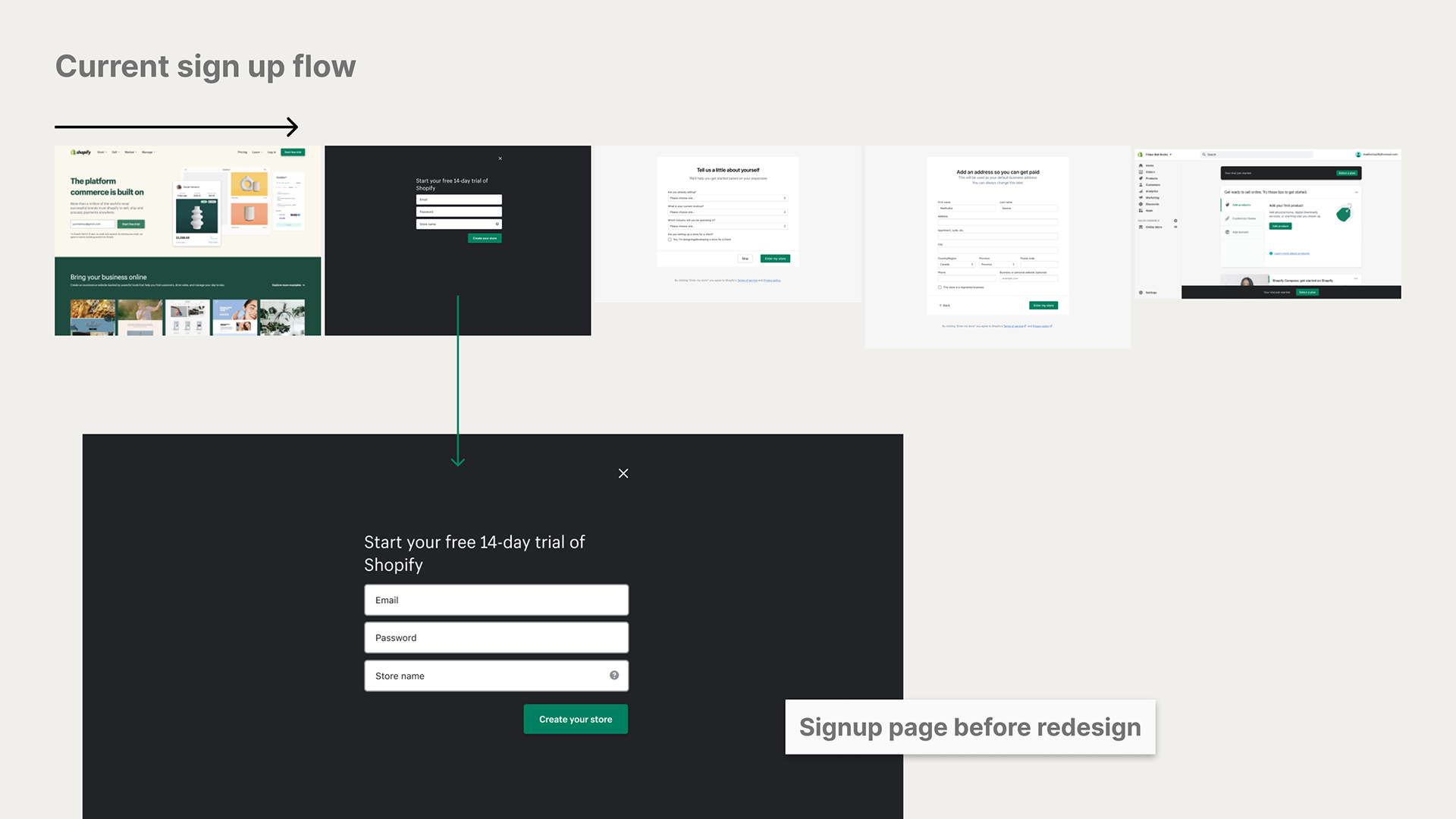
Currently, when a new user signs up to Shopify, they need to provide an email address, a password and a store name. The email and password are used to create their Shopify account, and the store name is used to name the store, and as the basis for the store domain.
Problem with the current sign up
The problem with today's sign-up was that about 50% of new users who open the sign up form where we ask for an email address, password and a store name do not complete it.
Digging a little deeper to understand why the high dropoff, there was evidence from the past research that shows choosing a store name is a creative step and many new merchants aren't ready to commit to a store name during sign up.
From the technical side, since the store name is used to generate a domain, it means the store name needs to be unique across all Shopify, which can create additional friction for merchants during sign up.
From merchant frustration (a site that we used to log all merchant complaints during support calls,) I also saw tickets that request changing the domain after sign up, which is not presently possible technically.
Goals
Business goal
The business goals for this project are to increase the User to lead and Lead to customer by improving the sign up process.
Project goal
The project goal is to rethink about the store name requirement during sign up and create an end to end flow that’s intuitive and address all edge cases
If the store name is creating so much friction during sign up, what if we don’t ask for store name during sign up?
After chatting with a few teams, I found that there was a previous experiment that attempted to reduce the friction during sign up.
The experiment had three variants:
1. Auto generate a random domain
2. Auto generate a domain from a list of template names
3. Generates an available myshopify domain name based on user input.
From variants 1& 2, we saw an increase in the leads, which suggests that the store name is still friction on the sign up form. From variant 3, we see a lift of L2C when decoupling the store name from the domain.
This experiment showed promising results led us to decide to defer the store name from sign up as a solution that's worth pursuing.
My role
My role for this project is to collaborate with the signup team to design an end-to-end flow.
The signup team works on the UI of the sign up page, while my role is to work on the downstream implication of the store name deferral.
Considerations
The decision to take the store name optional s a straightforward one; however, there are many considerations involved, such as:
- How many times should we allow changing domain per store?
- What are the downstream effects of deferring the store name?
- If the store name is not on the sign up page, where and when do merchants name their store?
- How do we drive merchants to name their stores?
Product/ Design/ Eng alignment on the direction
To facilitate the conversation between product, design and engineers, I map out all the possibilities of allowing the change for 0, 1 or 1+ times. The implication of the surface area and the pros and cons can be found in the image below:
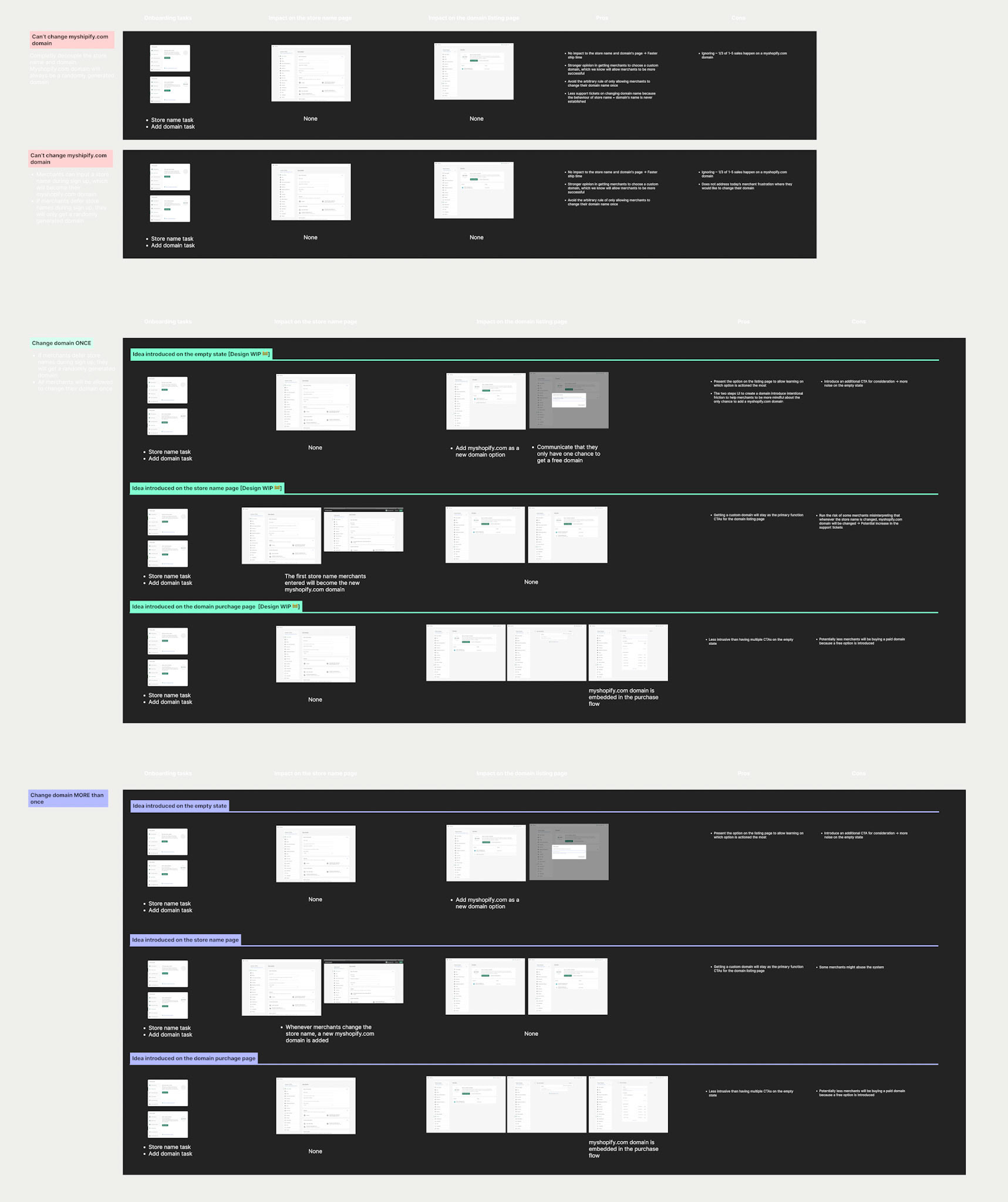
The team landed on the option of allowing merchants to change the store name once because not allowing merchants to change the store name means we aren't addressing the merchant frustration issue, while allowing merchants to change store name multiple times introduce technical complexity
Design principals
When there are many design iterations, it’s helpful to have guiding principals to help choose the final solution and the principals should align with the team’s goal.
1. Custom domain > myshopify.com
Even though we are allowing an additional myshopify.com domain, ultimately, merchants should still get a custom domain to be successful
2. Making the built in domain available but not prominent
Visually, the built in domain should not take precedent to the custom domain
Explorations & The Final Solution
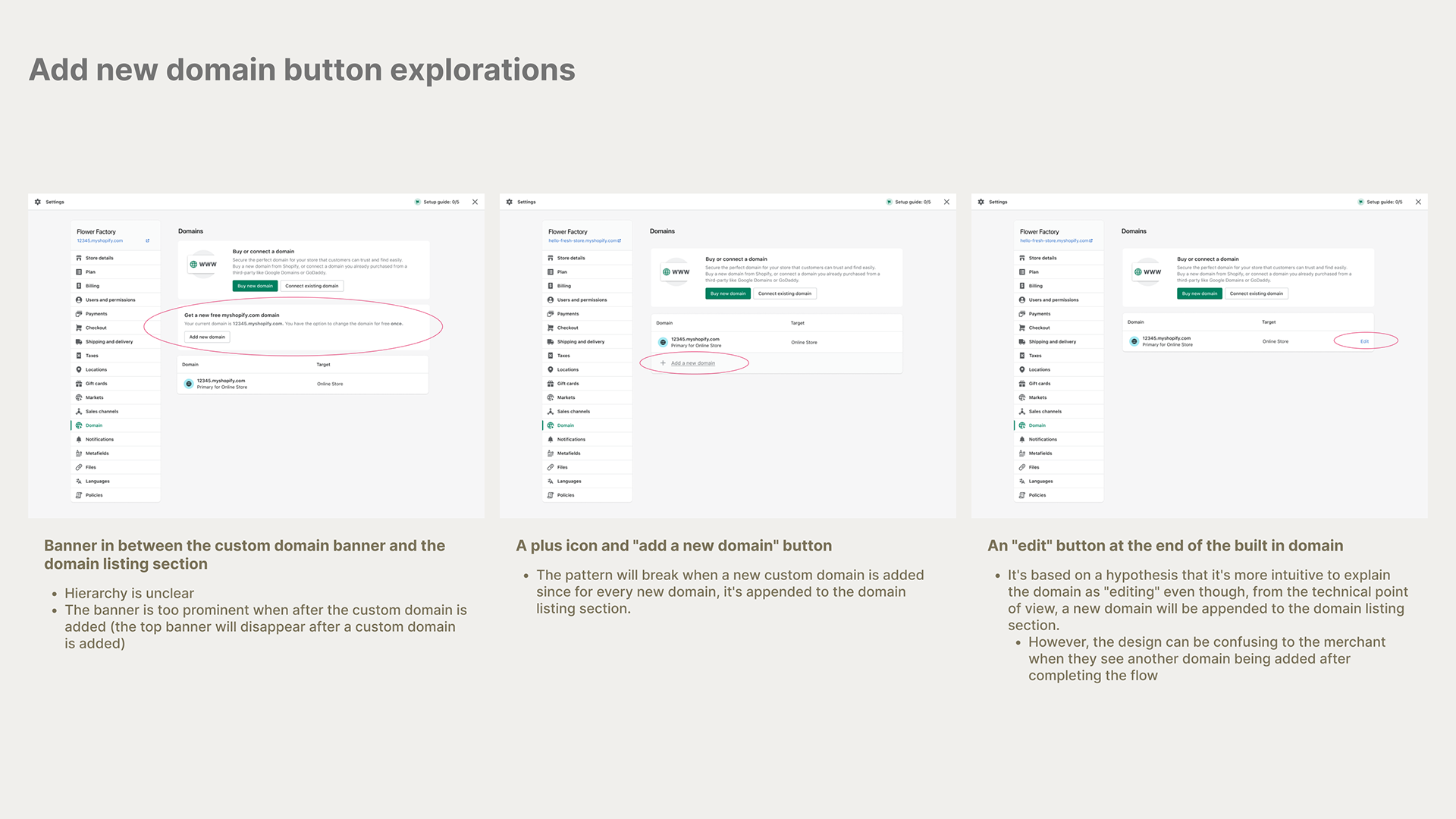
The final solution I landed on after the feedback from the team provided the least development time while taking scalability into account.
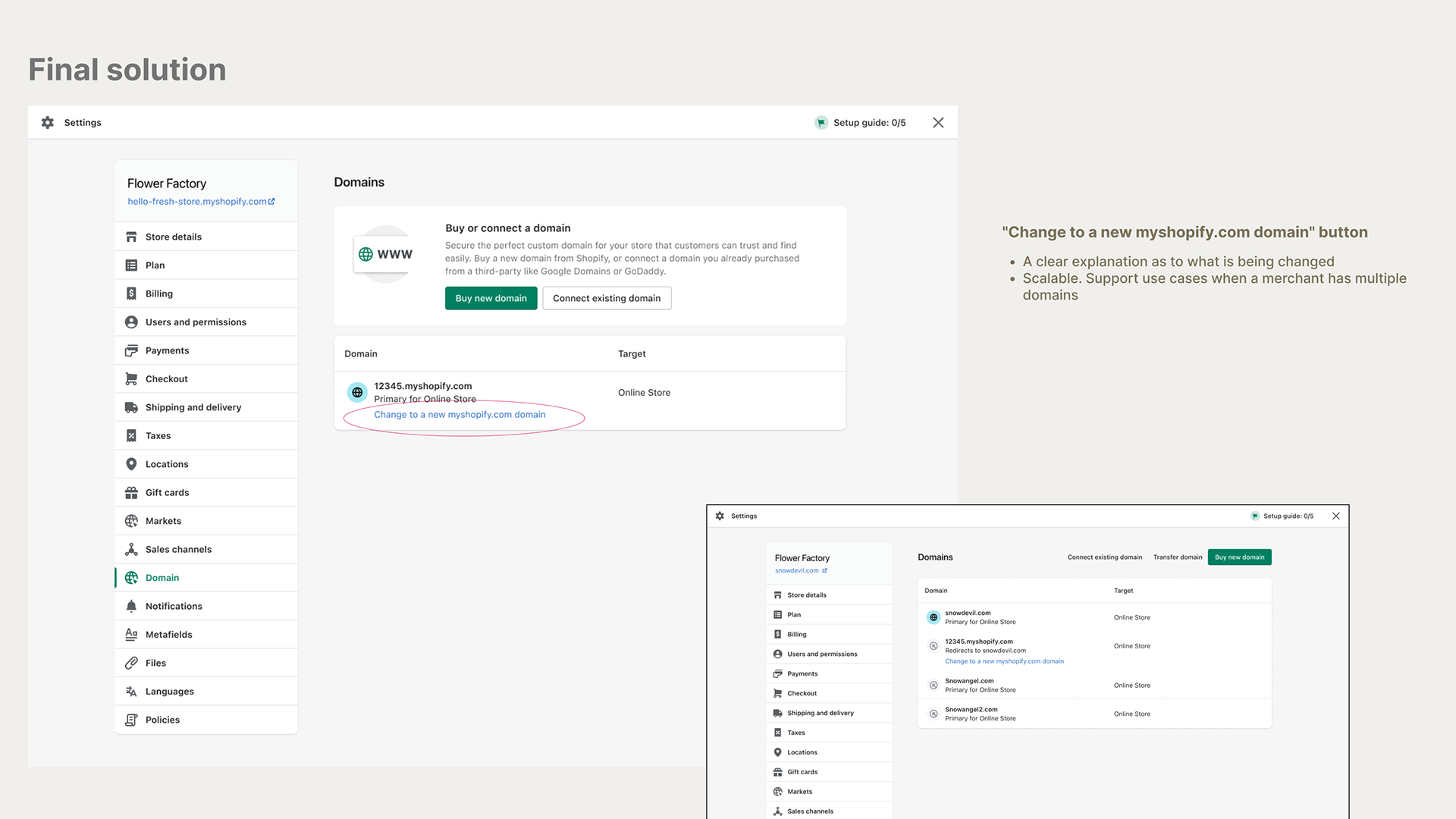
The changes in the pre-design and post-design flow
The design files are available upon request
Impact
We saw an increase in signup completion and conversion. The project was also highlighted in Shopify's first ever Edition (An initiative to update the public on Shopify’s new products/ features.)